Friday, March 30, 2012
Bureaucracy and Education
Thursday, March 29, 2012
Is there more to ROTA than just the projects?
Therefore, I am an individual who gives 2 hours of her time to help these workers learn a few English words, so that their bosses and employers have an easier time communicating with them. ROTA is also a utilitarian organization. A utilitarian organization indicates that the organization has a specific goal/ purpose and implies that some members get paid for running the few aspects of ROTA and is usually a matter of individual choice. I can strongly say this organization is not a Coercive organization. The aim of ROTA is to increase access to educationalfacilities in a crisis situation. The chairperson H.E Sheikha Mayassa bint Hamad Al-Thani and a few other Board members provide guidance and direction for the charity.


ROTA is a non-profit organization, and thus there is a limit of trust and liability issues that have to be kept under control and supervised regularly. These benefits of having rules is a functional point of view, a positive way to see an outcome in every bureaucratic organization. There is an achievement, which is education that is given and received by a range of individuals.
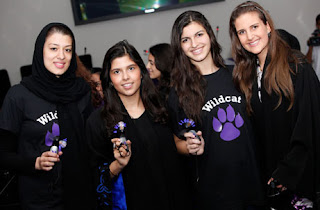
In Doha Qatar itself it becomes a social conflict because many Indian schools barely receive information about ROTA trips abroad or several local projects because the organization only picks people who have a certain amount of skills or study in Education City. Education City most of the time tries to get university or Qatar Academy students to participate in these projects, in order to build their Community and Serviceskills and approaches. The picture below is of a Carnegie Mellon University student teaching the cleaning staff of his University. As a teacher myself, I have noticed that there are no teachers from The College of the North Atlantic or Qatar University. The next picture identifies how serious ROTA takes their educational services because it shows the training sessions that occurred for all the upcoming teachers in Education City.
“Make a Difference and take Action” says ROTA.
Sunday, February 26, 2012
Modern (Not) Versus Traditional
In my own family, I notice that my parent’s roles are alike in some aspects but are different in others. For example, both of my parents are employed however, they have very different household responsibilities. My father is the one who provides us with a house but my mother turns it into a home. My father provides us with a quality education by enrolling us into the best schools but my mother comes home from work and helps us with our homework. Simply put, my father pays bills and my mother pays attention.
Growing up in a semi-traditional, semi-modern Arab family, I formed specific assumptions concerning what my role would be as a wife and mother and what my future husband’s roles would be as a husband and father. I know that as an Arab woman I am expected to know how to cook, clean and take care of the children at a minimum. Additionally, I am expected to work since more and more women of my generation are entering the workforce. I am expected to marry a man of the same social status as that of my own family or higher. My future husband is expected to have received an education equivalent to or higher than that of the one I did. He is also expected to be a workingman who can provide for his family by ensuring a house for them, good education for his children, and a comfortable lifestyle in general.
After taking a closer look into my own family, I realized how I am influenced by the modernization found in my generation yet still connected to my Arab roots. Societies are in fact shifting away from the old stereotype of the male being the breadwinner and the female being the home caretaker. However, they are not completely letting go of their traditional views.
Wednesday, February 15, 2012
Glass Ceiling barriers Can Be Broken!

The notion of glass ceiling could be the reason for gender inequality. In this case, glass ceiling is an invisible barrier that keeps women from reaching the highest ranks of jobs or industries. This may be the case with some women, but not with all women, certainly not Mercedes Duerineckx. She is the founder and CEO of the International and well known, Art Wanson Gallery. She has created a luxurious platform for all art expressions, under the trademark of excellence, tradition and exclusivity.

Women tend to face gender discrimination within higher education, but Duerinckx didn’t. She got her Business Administration degree in Tourism.

Duerinckx’s education and Art Wanson Gallery is not her only accomplishment. She has been awarded businesswomen of the year 1992 in Morocco, Founder and CEO in real state industry 1985-1992, and the executive member of Spanish Chamber of Commerce in Tanger.

She said that growing up in a multicultural family has helped her become who she is today. Duerinckx was born in a Spanish family in Morocco and later on moved to Spain and France. In sociological terms, she was raised in a highbrow culture, with a diverse cultural background.
Sunday, December 11, 2011
Education: At School and at Home

In one of our recent Sociology classes we learned about Education. The lesson was very valuable because we all learned that there is more than one method of educating someone. I personally did not actually take into account how everyone learns something everyday, and it is not necessarily at school. The act of learning in a systematic and planned way is known as formal education. When students pay to be taught in an institution facilitated to accommodate instruction of various subjects it is known as schooling. But the method in which people learn everyday is called informal education. Informal education happens spontaneously and is not planned.
Informal education is extremely important in our day-to-day lives. Ever since we were children, we have been both formally and informally educated, and of course gone through schooling. Learning how to walk and talk, and learning the language our family speaks are some of the first examples in our lives of being informally educated.

Whether it was watching mom cooking or playing basketball with dad, we were being educated in some aspect of life. I know that when I watch my mom cooking a traditional dish, I have to try cooking it after. Today, through watching my mom making a variety of dishes for parties and for the family, I know how to cook dishes like curries, pasta, and rice. This is also a slightly gender polarized job, and it socializes young women into taking up the role of becoming a wife and mother. I learned how to cook from my mom and how to play sports from my dad. This shows that there is a relationship between gender and informal education, particularly in learning about family responsibilities and chores as a child.


Another example of informal education is when you get involved in groups or organizations. I joined a choir at Church, and did not expect to learn about different voices and pitches or even how to read music scores. These things happened spontaneously and were not planned in being taught to the members of the choir. Joining any type of club or organization imparts informal education whether it is public speaking or learning how to be a team leader.


Formal education and schooling are also important because it teaches us the skills we need for specializing in a certain field, such as law or medicine. Formal education also involves paying for classes like guitar or piano, it does not always occur at a school. My brother and I took guitar lessons and it was a great experience to learn how to play a musical instrument. If we continue learning and become expert guitarists, we can then teach other people who want to learn how to play.


When our generation grows to become parents someday, we too will impart our knowledge of informal education to our children through teaching them how to walk and talk, teaching them morals, household responsibilities, and many other important aspects of life.
Saturday, December 10, 2011
You Think You Know Ghetto?

Tracking in schools play huge role in this situation. Tracking is when education systems sort students into distinct instructional groups according to similarities in their past academic performance, results on standardized tests, or even anticipated academic expectations. In most cases, students are grouped based on their test scores and past performances. Research suggests that this special curriculum exaggerates and widens the gap among students and continues the belief that intellectual ability varies according to social class and ethnic group. Thus, at most times, this influences the chances of a student’s dropping out of high school based on their racial and ethnic classification.
Halfway through class, our professor gave us a “You Think You Know Ghetto?” test. At first, I was surprised and wondered as to why he made us take the test. After completing it, it made me realize how if not all, but most tests I have taken are culturally biased! I realized that most standardized tests go to the extent of creating educational inequality and institutional racism, and reveal how most white students are privileged. The test gave me an opportunity to put myself in the same shoes as black students after taking a standardized test. The test “ You Think You Know Ghetto?” is a more contemporary version of the Adrian Dove’s famous “Chitling Test of Intelligence” first published in 1971. The test illustrates how cultural language differences affect objective measurements of intelligence in tests.
Some sociologists argue that African Americans demonstrate poorly in intelligence tests in comparison to white students. This gap is more evident in regards to African American language, attitudes, cultural backgrounds and even lifestyle. At most times, cultural content within intelligence tests leads to culturally biased results. As most of the people who design these tests are white and educated, their tests are culturally unfamiliar for dissimilar test takers. For instance, African American students do not use the same language, nor do they have the same cultural background. From this, we may also infer that dominant cultures set the parameters for minority cultures.
Thursday, December 8, 2011
Education, Culture and Society

Although the aim of schools is to educate students, sometimes the type and method of education is different. Growing up, I went to multiple schools and in different countries. I was born in Saudi Arabia and attended school there until the age of five before I moved to Scotland and studied there. After almost two years of living in Scotland, I returned once again to my previous school in Saudi Arabia. During this period in my life, I realized how different the education systems were. The type of schools were completely different as well.

Saudi Arabia is an Islamic and Arab country, so the majority of the schools taught and encouraged Islamic behavior and Arab culture. Manarat Al-Riyadh, the school which I went to in Saudi Arabia, was an International School that taught both American and British curriculum. In addition, Arabic and Islamic studies were also enforced on students even if they were not Muslims. The cultural and religious studies started from as early as the first grade and continued until the 12th grade.

On the contrary, when I was in Hillhead Primary School in Scotland, the curriculum that was being taught was very different. Unlike my previous school, in Scotland, my school emphasized mostly on manners, behaviors and how to work and interact with people. There was less emphasis on studies and more emphasis on social interaction. Also, there were no classes offered about Scottish or Western culture and no theology classes. Contrasting to Saudi Arabia, the students in my class were of different religions and cultures. There were Muslims, Hindus, Christians, Buddhist, Arab, African, Caucasian and Asian.
We can see how schools are designed to serve society by functioning as places for education, discipline and socialization. The curriculum for schools differ on which background they're from, nevertheless they're purpose is to socialize people to allow them to function according to their society.
Monday, December 5, 2011
From across the globe


As I sit day after day in sociology class, I realize how everything around me is derived from knowledge and understanding. The topic we zoomed in to this week was education. The focus was on the European Union, and how it functions in the world today. Education is a big word, or should I say, a big world. We follow complex systems and curriculums each and every day.
Schools are used as formal education. There is a set curriculum to be followed. My old school, for example, followed a British system, where the students in grades 9 to 12 or 13 took external examinations such as IGCSE’s or AS or even IB. These examinations allowed the students not only to experience the diversity of other cultures such as that of Britain, but also to see what is being schooled to children half way across the globe from them.
The child in a school like this is not only taught how to diversify his/her ideas, but also learn the culture of another country. This is what we call a ‘hidden curriculum’ where a child receives skills or benefits beyond the knowledge in the content of a book. Life skills, something such as being taught that ‘sharing is caring’ and ‘to stand out, is to excel’ is something that is not directly written in a book, but is conveyed within the classrooms.
Nowadays, schools have integrated a class titled ‘PSHE’ which stands for Personal, Social and Health Education. This class teaches children to take care of their health and balance their diets. Not only that, it helps them organize their thoughts and time in effective ways. It had become such an essential part of the core school curriculum that if a student did not take it, they simply could not pass to the next class.
The only problem with such educations and in private arenas is that it costs much more to send a child to an international school with a British system, than to place that child in a government school.
Confessions of a First Semester Freshman.


In high school, students are introduced to tracking systems in order to get the most out of the subjects they excel in. In university however, most classes are a mixture of students, from freshmen to seniors, all at different levels of their university careers. Another difference is the actual workday. Unlike the 7-hour-long days in high school, university classes are more lenient when it comes to scheduling, and it’s the time management and discipline skills we learned that help us with adjusting to that change. Students also become much more independent in college and aren’t “spoon-fed” as much as they were in high school to build up their self-image and character.
I’ll be the first to confess (as several other freshmen would); starting college was probably the most emotional, terrifying and exciting time of our lives so far. Emotional, because of the rapid changes we faced being away from family and friends; terrifying, because of the inevitable amount of stress, work and challenges coming our way; and exciting, because of all the opportunities that await us. With all the change happening though, I’ve realized that although high school is very different from university, it helped ease the transitioning process through both the formal and hidden curriculum.