Showing posts with label art. Show all posts

Sunday, April 15, 2012

Deviant art style?

Wherever you go, unless you go to Japan or Asian country, Anime will be looked down upon. whether it's just Anime, or Anime drawing style(Manga) or just anything related to anime.


But what I'm going to talk about in this post, is the deviance of anime style in the eye of westerners and western artists(mostly, and I'm not saying that all of them look down on anime art, but many do so).

I started to notice this problem when I started to attend university. I do not consider it a big problem, but I don't really feel comfortable when someone look down on anything I do ( since I draw in anime/manga style.) months ago, we had to draw a still life for our drawing class, Alhamdulle-Allah, my drawing was turning out quite well. My teacher noticed that I was doing pretty well so he approached me and asked whether I drew in regular basis or something, and I told him, "I try to draw everyday, I like to draw in anime style." just after I told him that, I felt like his face changed (not in a positive way) so, I just stopped talking after saying that sentence.
Not only that, but I get that negative vibe from some students as well. So I try not to talk about drawing with others unless I thought a person might not give me that vibe.

But since I have online friends from all over the world, I know that this problem is not only here, but it's rather spread. I have found blog posts about people with the same problem. (1-2)
People usually think that manga and anime style is just some people who just copy the Japanese animation and think of it as art, they think that each anime is the same and the style is just a copy of another. (But what if it was a copy? people actually learn many things from copying other works, it can also be called "inspiration", you can always copy but you can never claim that the piece you did is original. Artists back in Florence has been copying Roman architecture and monuments. why? because nothing produced is original, everything is a copy of a copy, of another copy.)
But what did they know? how can they say that all anime style is the same? [see picture below]


Why do some realism/drawing artists/professors think anime art is the 'lazy' style? why is it deviant to them? I seriously cannot comprehend that. I draw anime style, and I know what a person has to do to become better at drawing. First they should learn the anatomy (of almost everything, and how things work and function) and every professional anime artist practice anatomy, very much. Just like any kind of artist. Anime art requires hard work as much as any other form of art. It's certainly not lazy.


The Examples(pictures) above is mostly taken from anime series, but how about I show you anime art with a message and meaning to it?

Yuumei, is an anime artist who tries to convey messages and spread awareness through her art. Such as global warming, divorce, and many other subjects.


To conclude this post, I want to ask once again, why is anime art style considered deviant to many other artists? is it because the stereotype of anime style is the shiny-big-eyed-huge-forehead-cute-girls characters? or is it because it doesn't carry a meaning(which I should consider invalid, seeing Yuumei's art) or is it because people think it doesn't require hard work? does it do any harm to the society(I think not, just in some cases which is individual's fault, not the style) or is it because it's stylized and not realistic? (if that's the case, then why is Picasso considered one of the most well-known artist though his art was not very realistic?) But in the end, everyone has their own definition of 'Art' but they do not have to look down on certain styles with no good reason. 

Wednesday, February 15, 2012

Glass Ceiling barriers Can Be Broken!

When sociologists study gender, they focus on male-female differences in behavior and appearance that have been socially created. Sexism has brought many inequalities to women, especially within areas of education, work and politics. By sexism, I mean the belief that one sex- and by extension, one gender- is innately superior to another, justifying unequal treatment of the sexes. The concept of gender stratification becomes evident, as there tends to be unequal access to power, prestige, and property on the basis of sex/gender.


The notion of glass ceiling could be the reason for gender inequality. In this case, glass ceiling is an invisible barrier that keeps women from reaching the highest ranks of jobs or industries. This may be the case with some women, but not with all women, certainly not Mercedes Duerineckx. She is the founder and CEO of the International and well known, Art Wanson Gallery. She has created a luxurious platform for all art expressions, under the trademark of excellence, tradition and exclusivity.


Women tend to face gender discrimination within higher education, but Duerinckx didn’t. She got her Business Administration degree in Tourism.


Duerinckx’s education and Art Wanson Gallery is not her only accomplishment. She has been awarded businesswomen of the year 1992 in Morocco, Founder and CEO in real state industry 1985-1992, and the executive member of Spanish Chamber of Commerce in Tanger.


She said that growing up in a multicultural family has helped her become who she is today. Duerinckx was born in a Spanish family in Morocco and later on moved to Spain and France. In sociological terms, she was raised in a highbrow culture, with a diverse cultural background.

Friday, November 25, 2011

Deviating the Qatari Culture through Art

Deviance is a form of behavior that violates expected rules and social norms. There are various types of deviance. The major types of deviance include: formal and informal deviance. Formal deviance includes deviance that breaks the law such as robbery and rape. Informal deviance is deviance that violates informal social norms and rules such as swearing and burping.
 
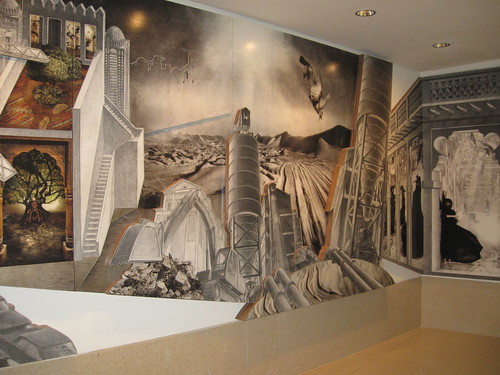
A current example of a deviant behavior occurred within VCUQ premise on November 2011.  The source of this deviant act is an artist from Mexico.  The artist painted a deviant mural painting. Her purpose of the mural painting is to portray cultural transition and women’s empowerment.  She had a good idea but the way in which she portrayed her idea was wrong and deviant.  It was both formally and informally deviant. She painted an explicit painting in public that is socially unacceptable. Such painting has never been drawn in Qatar in public as it conflicts with the Qatari law, social norms and rules as well as our Islamic religion.
 
Qatari citizens or locals have responded to such a deviant act by various methods; they spread the word via messages, they reported to local newspapers’ Al Sharq’, reported to the Dean of VCU as well as higher authorities.
 
Finally, we don’t truly know her true intensions of her painting. By seeking other people’s opinions through informal conversations, many believe that she has done this mural painting in a Muslim country in order to get her name out there and to be included in the list of the controversial artists and gain popularity. Others believe that she was just ignorant. And others believe that it’s a mere misunderstanding; the artist comes from a country where such paintings are acceptable. Deviance could be intentional or unintentional. There are many simple ways to avoid deviance if one wishes; the basic rule is just to be familiar with the host/home’s country’s laws as well as the culture.


Examples of acceptable murals in Qatar:


Example of a mural in Columbus representing women empowerment:


This video shows an Egyptian girl posing naked on facebook and twitter to imply freedom of expression during elections. It caused chaos in Egypt because of the conservative people in the country against liberals. The girl describes it as being "screams against a society of violence, racism, sexism, sexual harassment and hypocrisy."

Friday, February 4, 2011

The Museum of Islamic Art

Just recently, Qatar started to focus more on the aspects of culture and its portrayals. The Museum of Islamic Art is one of the places that offer stories about historical cultures and virtuosity through pieces exhibited. In general, the pieces of art presented in museums differ depending on the time they’ve been created, and they also refer to various religions, civilizations and geographical places. The democratization of museums has changed their function dramatically over the past decades. Anciently, people of high class or the elite were the ones allowed inside the museums, whereas the poor were not allowed to visit museums due to their social status. This misconception has changed, because overtime people began to realize that museums are not about classifications, but free art for everyone to enjoy.


The creation of the Museum of Islamic Art has combined the intelligence of the creativity of the western geometric construction and the originality of the Islamic architect. The museum is distinguished due to its main theme, which is the civilization of the Islamic art. The creator of the museum, I. M. Pei, who is one of the well-known architects in the field, traveled to many countries to study the Islamic civilization in six months. The museum is located on an artificial island based on Pei’s decision in order to avoid having the museum overshadowed by the development of the sea area.


The interior design of the museum is modern compared to its historical concept. The pieces of art are generally paintings, sculptures, vases, carpets, and more. Noticeably, many objects commonly had mesmerizing writing on them, which is known as ‘Calligraphy’. Calligraphy shapes some of the fundamental elements of the Islamic art, where its practice resulted in the creation of different scripts and methods of decorating surfaces or paintings. Furthermore, Arabs are well known for their scientific traditions that they inherited from the ancient Greece, Persia, India and other countries. The presence of science was reflected on many instruments that were engraved with numbers and scientific symbols.


The Museum of Islamic Art was one of Qatar’s first steps towards introducing different and historical cultures. The country is still working on developing its concept of a cultural city through well-established projects such as the cultural village along with new museums.