Showing posts with label Islam. Show all posts

Saturday, December 10, 2011

Women Rights

In our Sociology class we learned about feminism.Feminism is a collection of movements aimed at defining, establishing, and defending equal political, economic, and social rights and equal opportunities for women.
Feminist theory, emerging from these feminist movements, aims to understand the nature of gender inequality by examining women's social roles and lived experience, developing theories in a variety of disciplines in order to respond to issues such as the social construction of sex and gender.


What I am writing today will be from my own point of view. I will be including religions “Islam” point of view as well. I will be talking about women rights in Islam.

We all agree that women and men are both human, but does society think that they should be given equal rights? That sounds reasonable since they are all humans.
In another sense women are very different from men in their physical, mental, and emotional nature.
If equality between people of the same gender is impossible because of the differences of skills and abilities, so how can we request equality for very different genders?
Women and men are equal in religious obligations. Both are required to testimony of faith, prayer, fasting, obligatory charity, and pilgrimage. In certain conditions it is easier for women since they go through physical changes during the monthly period they are excused from prayers and fasting. Men and women are both equal in the financial and property ownership. In Islam women can go in to business selling, buying, owning, with no need of guard ship and with no restrictions or limitations.
Sometimes the society itself creates some rules, which put women whom go in to certain types of businesses in a category that are considered deviant.
In Islam Men and women are equal in the rights of getting education. The Prophet of Allah (Peace be Upon Him) said: Seeking knowledge is compulsory for each and every Muslim (i.e. both male and female).
[Ibn Majah #224 al-Baihaqi and verified]
The Prophet of Allah (Peace be Upon Him) said: The most complete believer is the best in character, and the best of you is the best to his womenfolk.
[Tirmidhi #1162 and verified]
In Islam they have equal punishments and rewards as Allah said in the Quran: (Whoever does righteous acts, whether male or female, while he is a believer, verily, to him we will give a good life, and We shall pay them certainly a reward in proportion to the best of what they used to do.)
[16:97]
There are much more rights that I didn’t mention that really shows how Islam honors women. To know more about women rights in Islam visit http://www.womeninislam.ws/en/women-right-islam.aspx


Wednesday, December 7, 2011

Structuring a Family

Polygyny is permitted in Islam because it is more matriarchal; the male has the right to marry four different women. The reason for this is because of the percentage difference in the number of males and females in the world and also to spread Islam. There are a number of different ways in which a woman and man are destined. In Qatar the most popular ways to get married is either based on arranged or love marriages.

Arranged marriage VS. Love marriage, as many may call it, give connotations of being happy and unhappy. The word arranged seems like as if the couple have no choice, being a trap, whereas love suggests happiness and long lasting.


In this generation, marriage has become different. This is mainly because of the development of Qatar, men and women seem to socialize more and gender interaction has increased. Therefore men and women meet in a number of different places which includes the university, workplace and many more. As a result of this development, young singles begin to think, why should I follow these traditions? Their mentality on marriage has changed due to their surroundings and they seek to marry someone they choose rather than their family choice.


Still, the marriage decisions differ from family to family. To some, marriage partners have been appointed ever since they were children, especially children the same age group. This is due to bringing families’ closer and for the continuance of the bloodline, which is considered arranged marriage.


Another form of arranged marriage is when the male chooses the specifications of the wife he wants; these specifications may include appearance, ethnicity, age, education level etc. The male’s mother begins to search by asking friends and family or even by looking at girls they think are suitable in places such as weddings, dinner parties, gatherings etc. Before anything is official and before the mother talk’s to the girls parents, she usually asks the male for his opinion before anything is official.

Nowadays, in Qatar, you can judge the success of a marriage based on the rate of divorce. Articles show that Qatar has one of the highest rates of divorce in the World. Many may perceive it as being the result of an arranged marriage and others see it as the interference of the parents in the couple’s relationship.


A number of reasons could result in divorce. These include; the social conflict caused by exogamy, with constant interference from the society and family. Another reason could be because of marriage based on love, one or both of the couples did not consider family responsibility and only based their marriage on love. Furthermore, other purposes for divorce is the result of arranged marriage, the couple did not get the chance to get to know each other before marriage therefore it resulted in a lack of communication and they may not share the same interests. Many possibilities can be the cause of unsuccessful marriages, whether from arranged or love. Also, vice versa, the success of a marriage can be either from love or arranged marriage as well.


This video shows the seriousness of arranged marriage - "a daughter's refusal to stay in an arranged marriage led to her death and resulted in her father's arrest". It shows to what extreme some cultures or families follow their traditions.

Monday, December 5, 2011

Marriages in our World


Arranged marriages (family choose the bride)

- Family choice from along time, when bride and groom where children. They might be related in a way or two families are friends.
- Or they choose the bride whenever the groom wants to get married she can be a cousin relative or anybody.
- Or the family chooses depending on specific things the groom wants in the bride. Ex (physical appearance, or social role, education..etc.)

Certain Choices can be affected sometimes by the family trying to:
- Maintain their social class with choosing the bride from the same class or higher.
- Keep the family name.
- Keep the blood in the same family (tribe point of view)
- Keep certain relationships.


Groom choice but arranged by family:

- Groom knows her (from work, seen her, can be a relative of his choice.. etc.)
He can even just have seen her for once and even never talked to her.
The grooms family proposes and after the acceptance they get engaged and then married.
The family for lots of different reasons can maybe sometimes refuse the groom’s choice. So that can cause a huge conflict with his family.


Self chosen and arranged by the groom:

Can be in reaction to social pressure and society and social constrains on his choice. Sometimes a one wants to get married to girl with different ethnicity, nationality, or religion..etc. So he finds a big rejection from his family and it causes conflicts with his society as well. Social pressure and constrains limits the boundaries of a grooms choices either by tribe or other differences.


Marriage in Islam

Islam
on the other hand considers it Haram to force a couple to marry each other. It advises people to get married to people from outside the extended family to avoid negative genetics and other negative affects.


Abu Hurairah related that the Prophet said: “Men choose women for four reasons: for their money, for their rank, for their beauty and for their religion, but marry one who is religious and you will succeed” (Bukhari, Muslim).
This of course, applies to women as well.


Friday, November 25, 2011

Deviating the Qatari Culture through Art

Deviance is a form of behavior that violates expected rules and social norms. There are various types of deviance. The major types of deviance include: formal and informal deviance. Formal deviance includes deviance that breaks the law such as robbery and rape. Informal deviance is deviance that violates informal social norms and rules such as swearing and burping.
 
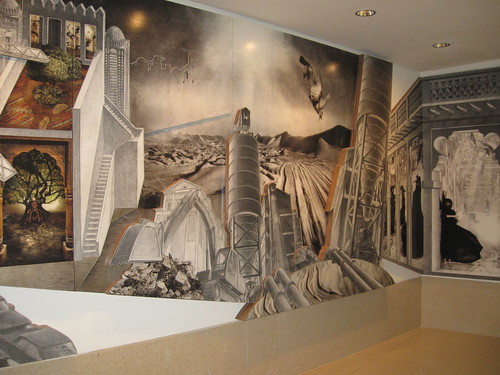
A current example of a deviant behavior occurred within VCUQ premise on November 2011.  The source of this deviant act is an artist from Mexico.  The artist painted a deviant mural painting. Her purpose of the mural painting is to portray cultural transition and women’s empowerment.  She had a good idea but the way in which she portrayed her idea was wrong and deviant.  It was both formally and informally deviant. She painted an explicit painting in public that is socially unacceptable. Such painting has never been drawn in Qatar in public as it conflicts with the Qatari law, social norms and rules as well as our Islamic religion.
 
Qatari citizens or locals have responded to such a deviant act by various methods; they spread the word via messages, they reported to local newspapers’ Al Sharq’, reported to the Dean of VCU as well as higher authorities.
 
Finally, we don’t truly know her true intensions of her painting. By seeking other people’s opinions through informal conversations, many believe that she has done this mural painting in a Muslim country in order to get her name out there and to be included in the list of the controversial artists and gain popularity. Others believe that she was just ignorant. And others believe that it’s a mere misunderstanding; the artist comes from a country where such paintings are acceptable. Deviance could be intentional or unintentional. There are many simple ways to avoid deviance if one wishes; the basic rule is just to be familiar with the host/home’s country’s laws as well as the culture.


Examples of acceptable murals in Qatar:


Example of a mural in Columbus representing women empowerment:


This video shows an Egyptian girl posing naked on facebook and twitter to imply freedom of expression during elections. It caused chaos in Egypt because of the conservative people in the country against liberals. The girl describes it as being "screams against a society of violence, racism, sexism, sexual harassment and hypocrisy."

Sunday, October 30, 2011

Culturally Religious

For some reason, Islam is automatically linked to Arab identity. It’s like foreigners don’t realize that Arabs can actually be of a different religion. What’s funny about this is that Arabs might forget that too sometimes.

Many of us Muslims grew up in a culture that is based on our religion’s pillars and rules. So, in Islam we follow a lot of the things that our Prophet, PBUH, did, such as saying “Bism Allah” (In God’s name) before starting a meal. I remember sitting at the dining table with my parents when I was younger; after they plated my food, they reminded me to say “Bism Allah.” Being my-not-thinking-before-I-act self, I chose to act out and break the norm and said, “mish Bism Allah” (not in God’s name). I obviously had no idea what I was saying. After that, I automatically got a negative sanction from both my parents, which is a negative reaction in sociology. Looking back at that memory now I understand exactly why my parents did that. Now, I actually understand what I said and why my parents asked me to say “Bism Allah.” It’s not something we just said for social reasons; it had religious meaning as well.


Here’s the thing, there is “haram” and there is “a’ib.” “Haram” basically means forbidden upon in Islam. “A’ib” means shameful in our culture. Sometimes it’s hard to distinguish between the two. An example of something that could be considered “a’ib” and not “haram” is being deviant by getting a crazy hair cut and dying your hair bright pink. If you go out to visit family friends or even just family it could be “a’ib” to walk in with a crazy hair-do and you will probably get a lot of negative sanctions. But in Islam, it is not “haram” to look like that. However, many culturally restrictive things are also forbidden in Islam, like one’s choice of wear. A woman is supposed to be dressed appropriately in public in Islam and in this culture.


The same goes to girls and guys mingling; it could be considered “a’ib” and “haram” at times. Girls and guys hanging out isn’t something that we see in public all the time, aside from in universities in Education City and at parties. It wouldn’t be so hard to find someone, at least one person, staring at you from the corner of his or her eye when you’re alone with the opposite gender, especially if you’re younger in age.

Thursday, September 29, 2011

Religious Diversity and Coexistence

A person who is not familiar with the Middle East and its culture would probably assume that the only religion practiced in the region is Islam. However this is not entirely true. Although Islam is the most widely practiced religion in the Middle East, Christianity, Judaism and Hinduism also have a significant amount of followers.

When I moved to Qatar 4 years ago, I was surprised to learn that there was religious tolerance here. Being Catholics, my family and I were pleased to know that there was a Church available. Although, at the time, mass was celebrated in a small establishment, the fact that us Catholics were given the premises to practice our faith was a great privilege. The official and much larger Church (Our Lady of the Holy Rosary) was completed and officially open in 2008. The Church itself is a symbol of our religion, and so being provided with the large area of land and the opportunity to practice in a proper location is considered an immense blessing.


As with all religions, Catholicism incorporates both material and nonmaterial culture. The Church, both physically and spiritually, is an example of material and nonmaterial culture. The fact that the Church is tangible, symbolizes Christianity, and is an essential component of our religion – the place where we celebrate mass and pray – establishes the material aspect of culture. The non-material aspect of the Church is what happens during a mass. When we all pray and sing together, we are united on a spiritual level, incorporating our values and beliefs in a common language.

In the Catholic Church, singing is of great importance and significance. It is believed that singing praises is more powerful than reciting prayers. I am proud to say that I am a member of one of many choirs in our Church. The choir that I am a part of loves to compose music that reaches out to the spirituality within people and which also makes the mass more inspiring.


The fact that two religions, Islam and Christianity, can coexist quite peacefully in a region where the dominantly practiced faith is Islam, contributes to the process of diversification. Coexistence is the essential element that will help, not only avoid conflict but in understanding people’s attitudes and beliefs.

Friday, February 4, 2011

The Museum of Islamic Art

Just recently, Qatar started to focus more on the aspects of culture and its portrayals. The Museum of Islamic Art is one of the places that offer stories about historical cultures and virtuosity through pieces exhibited. In general, the pieces of art presented in museums differ depending on the time they’ve been created, and they also refer to various religions, civilizations and geographical places. The democratization of museums has changed their function dramatically over the past decades. Anciently, people of high class or the elite were the ones allowed inside the museums, whereas the poor were not allowed to visit museums due to their social status. This misconception has changed, because overtime people began to realize that museums are not about classifications, but free art for everyone to enjoy.


The creation of the Museum of Islamic Art has combined the intelligence of the creativity of the western geometric construction and the originality of the Islamic architect. The museum is distinguished due to its main theme, which is the civilization of the Islamic art. The creator of the museum, I. M. Pei, who is one of the well-known architects in the field, traveled to many countries to study the Islamic civilization in six months. The museum is located on an artificial island based on Pei’s decision in order to avoid having the museum overshadowed by the development of the sea area.


The interior design of the museum is modern compared to its historical concept. The pieces of art are generally paintings, sculptures, vases, carpets, and more. Noticeably, many objects commonly had mesmerizing writing on them, which is known as ‘Calligraphy’. Calligraphy shapes some of the fundamental elements of the Islamic art, where its practice resulted in the creation of different scripts and methods of decorating surfaces or paintings. Furthermore, Arabs are well known for their scientific traditions that they inherited from the ancient Greece, Persia, India and other countries. The presence of science was reflected on many instruments that were engraved with numbers and scientific symbols.


The Museum of Islamic Art was one of Qatar’s first steps towards introducing different and historical cultures. The country is still working on developing its concept of a cultural city through well-established projects such as the cultural village along with new museums.