Showing posts with label material culture. Show all posts

Wednesday, October 26, 2011

Material Culture in Sudan

Culture is everything made, learned, or shared by the members of a society, including values, beliefs, behaviors, and material objects. Culture is learned, and it varies tremendously from society to society. We begin learning our culture from the moment we’re born, as the people who raise us encourage certain behaviors and teach their version of right and wrong. One important aspect of culture is Material culture. (SparkNotes)

Material culture consists of the concrete, visible parts of a culture, such as food, clothing, cars, weapons, and buildings. Aspects of material culture differ from society to society. (SparkNotes) Here are a few features of material culture in Sudan:


This is the traditional bride, where she must be covered with gold on her wedding. Also Henna is a necessity for married women, so they are known in the society that they are married. Also the Hena is a material object because is its a part of the Sudanese culture.


Also another part of the Sudanese material culture is tribal beauty marks its done by many tribes in Sudan. Which is when young girls, becomes a woman and eligible for marriage, her face will scarred in tribal patterns to represent that she is ready.


Another important material in the Sudanese culture is the “Toub” the national dress for women. Married women wore the “Toub”, which is a representation that they are married. Young girls are not allowed to wear. The “Toub” is also the identity that differentiates the Sudanese women from other women around the world.


Material culture is important in every culture and country, it defines the identity of each nation. In Sudan we have many significant material culture that presents Sudan, and known all around the world.


Here is a Video on Youtube that elobrates more on the Sudanese Culture

http://www.youtube.com/watch?v=OZtlwD2miUE


Source:

SparkNotes Editors. “SparkNote on Society and Culture.” SparkNotes.com. SparkNotes LLC. 2006. Web. 18 Oct. 2011.

Tuesday, October 18, 2011

Sociology on the road

Instead of learning from the typical power points presentations in class, our Sociology Professor, Geoff Harkness, decided to take us to the Al-Mathaf museum last Thursday during our 80 minute long class. We all showed up on time, which illustrates how disciplined we are to our role obligations. While we were all in the bus heading to the museum, we were all quiet and uncertain about how the trip will integrate the contents of our sociology syllabus. One of the students was brave enough to tell to Professor Harkness that museums are boring. Professor Harkness played his role wisely by responding “When I was younger, I didn’t appreciate museums, but as I grew older I started to gain this appreciation.”


Once we arrived, we were welcomed by the Head of Education Michelle Dezember who has a sociology degree. We spent the first 15 minutes discussing the formal organization of the museum. First to define formal organization; it is the coordinating mechanisms that bring together people, resources, and technology and then channel human activity toward achieving a specific outcome. So at the entrance, there were desks with computers that store the data about the visitors. An example of a formal dimension of the museum is asking the visitors about their nationality, gender, age and their visiting status to the museum. About the organizational values, the museum is quite flexible to the type of exhibitions it hosts. It’s not limited to a specific type of culture. It accepts exhibitions from various cultures, which highlight the involvement of significant cultural diffusion.


The museum had some norms like not entering to the Gallery hall with food and beverages and also not taking photos of the art work inside. The exhibition that we saw was called the Swalif project which means short stories. There were a plethora of traditional Arabic paintings but we only had time to analyze two paintings. The first painting was by Jassim Zaini and it was called oil on panel. The painting showed how the Middle East has gradually progressed towards urbanization. On the right of the painting, there were women on a rowing boat just simply sitting, and a young boy fishing with a stick. But moving onto the middle and left side of the painting, there was a man holding a book and switching on an industrialized oil panel. There were also two men lifting some heavy objects and a man fishing with a huge fishing net. The painting explained an aspect of the gender roles in Arab countries which was that men are the ones expected to work hard and engage in some physical labor and technology, while women are expected to just take care of the family and support them. The background of the painting had some buildings which is a symbol modernism. There were also palm trees and a sun, which are quite common in the material culture of the Middle East.

The next collection of paintings was done by Sultan and they elaborated again the role of women in the Arabic society. The paintings showed women in their homes, sitting on the ground and grinding bread or cooking. The women were wearing their long traditional dress and burqa,which explains how conservative the Middle Eastern culture is. Also, the women in the picture had many serving plates beside them, which reflect the symbol of generosity and hospitality of the Arabian culture.


Head of Education Michelle Dezember

The trip was immensely enjoyable and educational at the same time. Many thanks to our Sociology Professor ,Geoff Harkness, for his creativity in planning for our class and making us more interested in the study of sociology.

Tuesday, October 4, 2011

Unleashing the Qatari Culture in the Residence Halls

On September, 27th, 2011, one of the female residence halls in Education City in Qatar hosted an event to educate the International students about the Qatari Culture.The CDA’s and the residence hall director arrived before the event to set up all the items which represent the material culture of Qatar. These items included the traditional sofas, Arabic music, local pastries, regional dresses and henna cones.


A total of 16 students made it to the event. Most of the students came from Middle Eastern and Asian countries. However major western influence reflected the way these students dressed and talked. The fact is that Education City, which consist of six American universities, sways the subculture of the students to behave in a more western-oriented manner. They all communicated in English since not everyone from the attendants could speak the Arabic language.


Throughout this social gathering, I noticed many aspects of the non-material culture of the country. For instance, folkways like greeting everyone in the event by kissing on both cheeks were firmly applied. Also, the attendants showed open-mindedness and respect towards each other, which is a value embraced within the Qatari Culture. There were norms like maintaining the cleanliness of the place by disposing all tissues, paper plates, plastic cups after using them. Everyone made sure that they kept the pillows of the traditional sofas in the correct order after sitting on the sofas. The music was played at a modest volume. These examples illustrate how keen the Qataris are about living in a hygienic and organized place.


Back to the material culture, the students indulged in the two large dishes of the freshly baked chicken, meat, spinach and vegetable pastries known as fatayer. The portions were huge and this explains the concept of hospitality and generosity when it comes to dining in the Arabic culture. The students had fun trying out the Women’s traditional dress which corresponds to the beliefs of Islam in the culture as the dress was very conservative. Also throughout the event, the students were excited to get their hands decorated with the complex henna designs as henna in the Qatari culture symbolizes beauty.


Adding to all the energy of the occasion, one of the students turned 19 on the very same day. Matea Malikanovic a freshman at Georgetown University celebrated her birthday among the many students in the event. No one knew that her birthday was on that day so there weren’t any preparation to celebrate the occasion to its full potential. However they did sing her the popular birthday song and exchanged birthday wishes, which showed an example of cultural diffusion. Originally from Bosnia, Malikanovic shares a glimpse of her past, “I was born during the war,” she states. However, the situation has improved immensely since then. Still, she decided to study in Qatar to gain a better understanding of the culture and religions of the Middle East.


Birthday girl


A role is the behavior, obligations, and rights expected of a social status. The role of an Education City student involves committing to your schedule, submitting your assignments on time, participating in class and of course passing exams. Despite the busy academic schedule of most the students at the event, they were all looking forward to relaxing and enjoying their time. In fact, 9 students had exams the next day. Elizabeth Boctor, a Weill Cornell student said “I have no idea what I’m doing here but I know I’m happy.” Similarly, Sarah Omar, from Georgetown University expressed her excitement on attending the event, “We are enjoying free food and seeing people we normally wouldn’t see because of our busy schedules.” This casual get-together permitted the students to step out of their rigorous role and engage in leisure and social activities.

While the event only lasted for two hours, it gave students the chance to renew their motivation for studying and refresh their energy. It also helped inform them about the various aspects of the Qatari culture.

Saturday, October 1, 2011

A Bangladeshi Engagement Party: Observing Culture and the Process of Socialization


Qatar Foundation is a perfect representation of the multicultural society that exists here in Doha. According to the QF website, the QF community is made-up of 90 different nationalities. Being exposed to so many different people allows you to interact with, and learn about these cultures that can be found in one oasis. Whether you are a student, staff or faculty member in Education City, your chances of experiencing a taste of culture from all around the world prove to be unique and worthwhile. Here’s an example…


A few weeks ago, I was invited to Rezwan and Samira’s engagement party, friends of mine who were both students in Education City. Rezwan and Samira are both Bangladeshi. They share the same culture, languages, and understanding of the material and non-material culture that they grew up to become accustomed to. Culture has a social context. And my friends to be married, have both undergone a process of socialization in which they have learned and acquired a certain way of life, and a sense of self in the society they live in, in Doha as well as in the social environment of their homeland in Bangladesh. The process through which the Bengali way of life or identity that both Rezwan and Samira have learned, accepted, and taken as his or her own is called internalization. According to the book by Ferrante, through this process of internalization, the norms, values, beliefs and languages are passed on to them by their socializers.


The Bangladeshi people all belong to a group in which they share a distinct identity, interact with each other, and feel a sense of nationality, pride, belonging, and membership. There are different types of groups that act as agents of socialization. And the people who are probably the most influential in terms of passing on the Bangladeshi cultural identity to Rezwan and Samira are family members, especially parents, and elders – people who belong to the primary group, a social group in which members have strong emotional ties.


A Bengali wedding ceremony or any other party prior to a wedding such as an engagement celebration differs greatly from one that my family would host. It was a very interesting and enjoyable experience sitting there amongst his family, and friends (who were not entirely Bengali) watching what went on in this beautiful gathering. A wealth of sociological terms and concepts can be applied to all the elements I observed in the three-hour period I spent at the party. Everywhere I turned, I wanted to shout out one of the theories from class. But I saved it all for the blog, and stuck to “congratulations”.


As soon as I stepped into the party hall upstairs in the Indian restaurant called "Aalishaan", I was surrounded by symbols, material culture and non-material culture. The material culture consists of all the natural or man-made objects with attached meanings, for example the food, the traditional clothing, the festive decorations and gifts. The non-material culture includes the Bengali language, the values (the respect for the elderly, and the behavior towards them), beliefs (pertaining to the Muslim faith) and gestures (greetings, and ways of interaction among the guests and hosts, and celebration activities).


According to Ferrante, socialization involves both nature and nurture. Rezwan and Samira’s genetic make-up, “physical appearance” or biological inheritance, are related to nature. They “look” Bangladeshi, and similarly their Bengali friends, and family, look Bengali too. On the other hand, the social environment I witnessed including their primary group of relatives, close friends and family, and the interactions between them, are all considered the nurture part of socialization, through which Rezwan and Samira live their lives, have social experiences and human interactions. Although their appearances might suggest they are Bangladeshi, there is a reason why some of their relatives for example, do not speak English. Their relatives have not acquired the same education, experiences, and social contact as Samira and Rezwan did. Hence, nature and nurture are both critical to analyzing the process of socialization and either one cannot be ignored.


The ceremony started off with a Qur’an recitation, when all guests remained seated and quiet, followed by a short speech. A significant symbol was used to signify to people that they are expected to be still and quite for the recitation of the Holy Qur’an. That symbol, also used frequently prior to proceeding with a significant act or movement, is the phrase of two words in Arabic “bismullah” meaning, “in the name of God”. As soon as the speaker said those words, everyone sat down, and stopped their conversations, waiting attentively, knowing what to expect afterwards. Another example when this symbol was spoken is before the slicing of the cake.


The cake segment, was one of the one most intriguing and amusing of all the events in the party to me. In Bangladeshi culture, feeding sweets to the bride by all elders, relatives and those involved, is a key part of the ceremony. The glowing bride Samira, had to watch the big mouthfuls being fed to her, piece by piece…and I could see how the poor thing tried so hard to nibble off smaller manageable bits. Everyone wanted to take part in the feeding process, even the bride’s younger brother. Cake was flying at her at a constant speed. Luckily her husband-to-be finally took over, and he and Samira both started feeding their closest relatives in return.


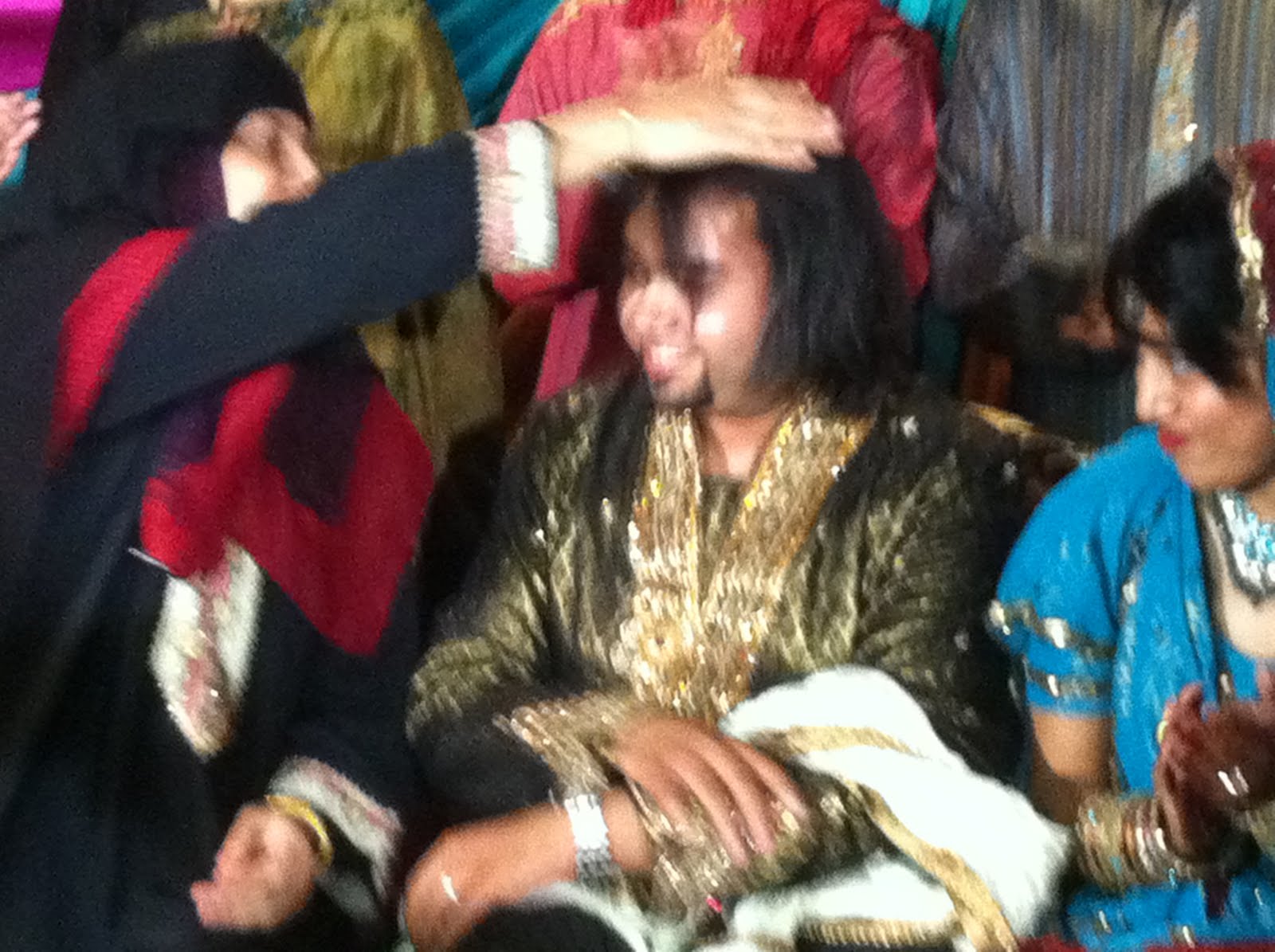
This may be seen as a symbolic gesture between people of group in which the act of feeding cake to each other conveys a meaning of love, blessing, gratitude, respect, good will, and value from one person to another. Other examples of symbols and gestures include the gestures for expression between the mother-in laws to their son and daughter-in-law and the gesture in which Rezwan and Samira’s mothers placed their hands on the bride and grooms heads and hands as to bless them, also saying at times, short versus from the Qur’aan.


Another important part of non-material culture, that is also symbolic in nature, includes presenting the gifts to both the bride and groom from the mother-in-laws. Rezwan’s mother presents Samira with a gold bracelet and ring placing them on her arm and finger. And Samira’s mother presents Rezwan with a new watch, and also places it on his arm. This exchange of gifts is considered part of the engagement process, where both sides present gifts as meaningful tributes. The act of giving the gifts is the non-material culture, and the gifts themselves, can be considered tangible material culture.


Other tangible material culture includes all the different aspects of the bride and groom’s wardrobe: clothing, accessories, veils, bracelets, necklace, rings, jewellery, and henna.


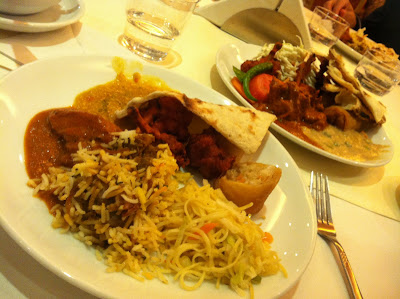
The food that was served, was Indian cuisine not Bengali. And although there are a lot of similarities between the two in terms of spices and key foods, serving Indian food at a Bengali ceremony could be considered a form of cultural diffusion, in which other cultural items are borrowed from a source outside the Bengali culture.


Finally, all of these shared experiences, gestures, symbols, that are recalled, reproduced, and repeated in this ritual (engagement ceremony) or event are passed on from generation to the next in order to be sustained and preserved. Socialization is impossible without memory. Therefore, the only way through which this preservation and passing on of experiences is possible is through collective memory. Without collective memory, Rezwan and Samira’s families wouldn’t have passed on experiences that shaped the “Bangladeshi” engagement party I attended, groups with particular identities would seize to exist and I wouldn’t have been able to remember any of the things I just wrote about in this blog post!

Tuesday, September 27, 2011

The popular Culture in Clueless the Movie

When we feel impotent and out of control, and feel we are in need for a sanctuary in a place where we could gather our thoughts and regain our strength, where would we go? Well, according to Cher, we should go to the mall!  
 
Cluelessis a comedy film directed by Amy Heckerling that was produced in 1995. The story is based on Jane Austin’s novel “Emma”; however, the setting is different, where the story takes place in Beverly Hills in the 1990s.
The film portrays the material and non-material culture of Beverly Hills’ high school kids, with all their values, beliefs, and norms.  Cher, the main character in the film, is a rich teenager, whose mother died long time ago while undergoing liposuction. She is obsessed with fashion, shopping, and matchmaking; yet, she is not interested in dating high school boys. Her ex stepbrother Josh is a college student, who keeps teasing Cher for being selfish and superficial, and tells her that her only direction in life is ‘toward the mall’. 

The film portrays the popular culture in Beverly Hills using sarcasm. Most of the people are materialistic, obsessed with fashion, dating, and plastic surgery. For example, a lot of high school girls had a bandage on their noses, and some on their chins, which mocks the fact that plastic surgery, and especially having a nose job, is a normin this society. Moreover, one of the girls, trying to avoid tennis practice in school, tells the teacher that her plastic surgeon doesn’t want her to do any activity where balls fly at her nose. Another thing that contributes to this irony is the death of Cher’s mom while undergoing a liposuction surgery. The obsession with fashion is also exaggerated and observed when Cher designs her clothes in the morning on a computer screen rather than on her own body.


     This is the common culture in Beverly Hills, or the large subculture of the rich. People are expected to be fashionable, and this is shown when the new girl arrived to the school looking like a farmer, as one of the girls said. However, Cher and her friend Donnie decided to use their popularity for a good cause and start their “project” to give the poor girl a new look, so she would be able to fit in their society. Moreover, The girls have their own female language including terms that substitutes for things like period and sex. 

The film portrays the materialistic life people in Beverly Hills live. They understand the language of brands, the shopping mall is considered to be a place where Cher can concentrate, think and get focused. As Josh, Cher’s ex-stepbrother, says, Cher’s ‘only direction in life’ is ‘towards the mall’.  According to Coonie, ‘Cher’s main thrill in life’ is to give someone a makeover, ‘it gives her a sense of control in a world full of chaos.’   

The popular cultural represented in the film was shown to an extreme level of exaggeration and irony, however 16 years after the film release this popular cultural, based on materialism and consumerism, is now found not only in the US but also worldwide.


Monday, September 26, 2011

The sociology behind conquering Everest

Mountains contribute significantly to the material culture of Oman. However, the Omani society hardly explores these mountains through hiking or climbing them due to the extremely hot climate and lack of awareness among the citizens in participating in such adventures. Nevertheless, a 37 year-old Omani has succeeded in putting Oman for the first time in the mountaineering records. Khalid Al-Siyabi, a general director of IT in the Ministry of Education has reached the summit of the World’s highest mountain, Everest, at 8848 meters above sea level. On the 10th of July 2011, I was honored to interview this motivational personality to feature him in my first book “The Ultimate Wellness Inspiration.”

Here is what we talked about:

Training for Everest:

Khalid’s concept to be well-prepared for this extraordinary challenge was to incorporate physical and mental training. For his physical training, Khalid was running between an hour to three, cycling, climbing and swimming everyday. Regarding his mental training, he invented a technique called “ The Extra Mile.”, which is whenever his mind starts to send the “I can’t do it” signals, for instance in the last 5 minutes of his run, he increases an extra 5 minute as a punishment for his complaining brain. This helps him to achieve his adventurous goals no matter how hard it gets.


Climbing Everest:

There are multiple norms that Khalid followed to start his journey. First, he had his full gear in check which includes climbing boots, linear socks, technical clothing, wool hat, ski goggles, gloves, harness, sleeping bag, compass, water purifier, cameras, walkie-talkies, satellite phones, first-aid kit and sundries. The functionalist theory was obviously applied during the expedition as Khalid was accompanied by 19 fellow climbers coming from Argentina, the US, Canada, the UK, Ireland, Turkey, Finland and Australia. The age range was about 35 to 60, and there were 3 women in the team – 2 Canadians and one from Finland. There were 36 Sherpa who guided them throughout the expedition. Despite the differences of the culture of all the participants in the adventure, Mount Everest united this diverse subculture.

Khalid took 60 days to reach the top and seven days to go down. Khalid explained to me why it takes so much time going up; it is the acclimatization process. In order to go to a higher level our bodies need to get adapted to the new tough circumstances, so the climbers take it gradually by spending an hour in the new level then come back down to the original base camp. This gives their bodies a chance to make more red blood cells and gives a chance to the person to recognize his capabilities in going further or not.


When Khalid reached the peak, he was really angry for celebrating his semi-achievement on his own as many of his fellow climbers reached the summit at different times and three of them died trying. This explains how solidarity is important for one to stay happy with life. So in order to remain positive, Khalid planted the Omani flag on the summit as a symbol of patriotism and pride for his country.

However, thirty minutes later Khalid noticed a vicious avalanche making its way to the top and it would take Khalid around 6 hours to make his descent. So he decided to wrap his 9 liter bag pack around his waist, sit on it and slide downwards as the fastest way to maybe escape the disaster and with his great faith in God and focused state of mind, he arrived down safely.


His winning formula

The non-material culture embraces some components that emphasize the reason Khalid is able to accomplish such spectacular goals. His strong self-belief has empowered him to stay committed and motivated to endure his brutal training because the outcome is valuable. To be honored by a lot of key people in Oman and be recognized as a symbol of inspiration to all the rising Omanis, made Khalid feel fulfilled and encouraged to give more for his country. He also volunteers in motivational speaking in schools across Oman. After the mind-enriching interview I had, Khalid showed me on his laptop one of the inspiring presentations he had done during his motivational speeches. Not only was I astonished by the photos and videos of his thrilling undertakings, I was also on the edge of my seat ready to conquer my fears and take my life more seriously. And four magic phrases I learned from this fantastic personality were Don’t Complain, Be Positive, Commitment and Trust. With such optimistic mindset, we can all climb Everest!!


Khalid and I among friends hiking in Oman

Wednesday, September 21, 2011

Abaya - A Fashion Statement


Butterfly, fold, and jumpsuit are three of the many names given to the designs of the modern Abaya. Originally, it was a cultural garment worn by women in the Middle East to cover up the shape of their body. In fact, women in the past did not have to wear it since most of them covered themselves up modestly. Today, in the Gulf countries in particular, the designs are constantly in change, depending on the trending world of fashion. Rather than having a loose black cloth, it now comes in various shapes and with multiple embroidery designs.


Since the clothing under will not show, girls tend to portray their fashion sense by the Abaya they are wearing. Not only is it a type of material culture that women use to cover up, but it also shapes the social relationships. I remember having a Syrian lady visiting us in Doha. She was shocked by how the Qatari girls wore the Abaya. It was a culture shock to her, as she was used to the plain loose black cloth, and not the multiple designs. However, since the material component is shaped in some way by the non-material culture, she has adapted to this trend as everyone else was following it, and is seen as a sign of modernization.

New designs are out everyday, ranging from very loose to very fit. Those designs come from other countries and act as a cultural diffusion. The neighboring countries influence us. Therefore, when there is an Abaya exhibition such as Heya or a fashion show, young designers from all over the Gulf countries would display their unique designs, and the Qatari girls would buy them. Here are a few abayas I bought from the Saudi section


The young girls here are attracted by each other’s unique Abaya designs. I was ordering popcorn before entering the movie at Villaggio, and I saw this girl wearing an Abaya that attracted my attention. So I went up to her and asked her where she got it tailored. She replied by saying that she had it made in one of the Abaya exhibitions held at Doha Exhibition Centre. I kindly asked her if I could take a picture of the Abaya in order to make the same. Here is how it looked like.

Not only is the influence regional, but is also Western in some way. For example, in one of the exhibitions, I saw a design that had studs on the shoulders, along with others that were “funky”. I kept thinking inside my head that I saw those designs on a dress a star was wearing, and now it is implemented on the Abaya. Lady Gaga acts as a major influence to all those girls that want their Abaya to be extra original. Also, recently young girls have their Abayas tailored in a way that it would look like a jumpsuit from the bottom, which is also influenced by the West. I have also seen girls that deliberately shortened their Abaya, and when I first saw it and asked them why, they would say that they wanted to show their heels off. I completely understand that it is a cultural norm, and those designs just keep getting updated by the day.