Showing posts with label Palestine. Show all posts

Sunday, October 16, 2011

McDonaldization in Your Homes!

As soon as you walk into someone’s house you could automatically get a sense of the culture. Some houses even have a particular smell that could identify where the residents are from. Walking into my friend’s house I mindlessly recognized the scent I smell in all Sudanese houses I enter. This is actually the scent of some products they use in the house that are shipped in to Qatar from Sudan. The next thing I notice is the color and brightness of the house. It’s usually white and more blunt than my house for example, which gives their space a more temporary feel. A lot of the Sudanese houses I’ve been to use white lights, in contrast to mine, where we have warmer lighting.


You get a sense that the Sudanese residents don’t really consider this house in Qatar their home. Whereas for Palestinians, who constantly struggle to live in a subculture, try to make these houses their homes. When I say subculture, I mean a smaller culture within another culture that Palestinian usually live in. Palestinians use warmer colors, a lot of carpets and really design their houses in a way to make it feel like a home to them. In my home, and a lot of Palestinian homes I’ve visited, we try to add a lot of Palestinian elements to the house as a reminder of that place we “belong to,” even if we didn’t buy these objects from Palestine.


Sudanese usually have a lot of African and tribal objects around their “temporary” house that are bought back from home, to remind them of that place that they will eventually go back to, their real home.


However, the households did have some things in common. To begin with, there was a feel of alienation, which could be defined as a state-of-being where human life is dominated by the forces of its own inventions. The houses were machine-dominated. The families weren’t connecting in conversation, but most of the family members were watching TV. While the teenagers or working children were on their laptops, connected to the Internet. Some of the younger children were playing video games.


When the mother or housemaid cooked or even made tea, they would use a kettle, microwave, gas-run oven and so on. Everyone in the house was using a machine. Some of the siblings even communicated through the use of their cell phones, instead of verbal communication. So, even if the culture is different or the dialect they use is different, whether you’re Sudanese or Palestinian you are influenced by this idea of “McDonaldization.” In sociology, McDonaldization is a process where society is increasingly run like a fast-food restaurant. This means that we’re all being influenced by the idea of rationalization and even households could be modernized some way or another. This definitely can’t sound very literal, where a household could never really be a McDonald’s. However, all homes try to be as efficient, predictable and controlled as possible. They have a set of rules to be followed, try to be as efficient as possible with time, money etc. and predictable with honesty and the open relationship everyone has with one another. With time, the children in the house and the parents start demanding more. Here, control and calculation come in, where they need to monitor the amount of things they buy and consume.

Tuesday, September 20, 2011

Will They Ever Belong?

At seven years old Abu Afif was told he was going on a little vacation and that he would return to Palestine after 10 days, while things settled between Israel and Palestine. Almost sixty years later, Abu Afif, like millions of other Palestinians, still hasn’t returned and lives in Burj Barajneh, one of several Palestinian refugee camps in Lebanon. Three of the main countries the Palestinian Diaspora spread to were Syria, Jordan and Lebanon. In Lebanon, there are 12 refugee camps that house thousands of Palestinians each, building their own societies within a larger Lebanese society.


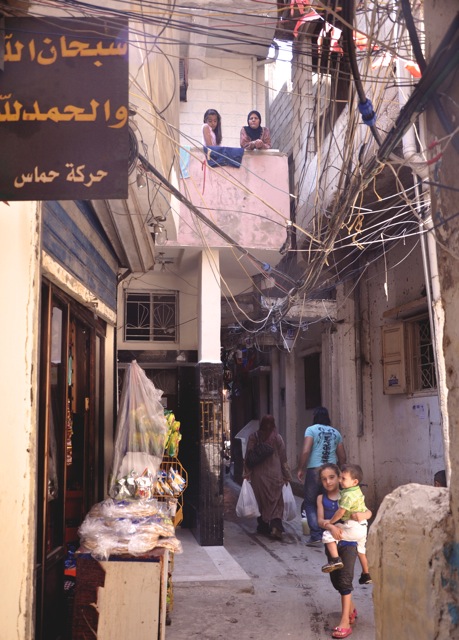
Burj Barajneh was the camp I stayed in for two weeks this summer. We drove
into the only road in the camp. As I got out, walked to my temporary “home,” I had to zigzag my way through numerous alleys that flowed with sewage and waste. Trying to look up to the sky, there was nothing to see. All I saw were countless electric wires.


Like Mexicans in the US, Palestinians in Lebanon suffer from minimum wage. Palestinians cannot usually find jobs outside the refugee camps. However, if they do, it’s probably a low-wage job like a painter, carpenter and so on. Many refugees graduate from medicine, engineering and other majors. But later, they unfortunately find it very difficult to work in their field. If they can’t find a way out of the country to somewhere where they could actually do their job, they end up opening a small business in the camp itself for very low incomes, or they divert into another direction in life.


Due to their economic, social and political background, Palestinians have created a new culture that will allow them to adjust their way of life to this subculture that they have created. The term subculture in sociology basically means a smaller group contained within a larger culture, so a world within a world. Palestinians have established and try to maintain their identity and culture within a complete different culture, the Lebanese culture.


Palestinians in Lebanon also suffer from an identity crisis. Like many other Palestinians around the world, they don’t really have a culture and try to adapt to what they hear about the Palestinian culture. The only home they really had was taken away and the “home” they currently live in can’t really be considered a home because it could be taken away from them at any time.